Review by Donna Telloh
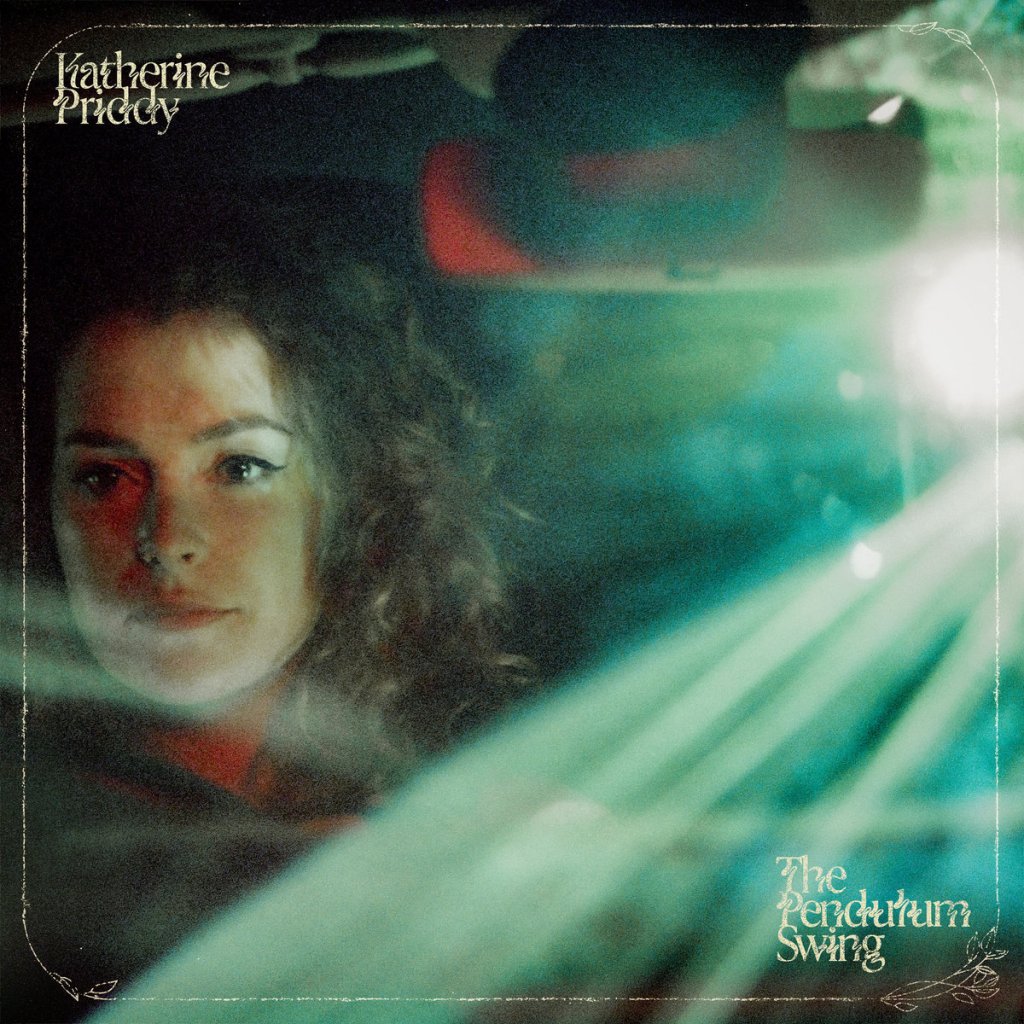
The album art for Katherine Priddy’s newest release, her second studio album The Pendulum Swing, features the artist herself, her surroundings obscured by blurred streams of light. The only details clear enough to make out are the rearview mirror to her left and the slightest indication of a steering wheel before her. So she’s in a car, but where has she just arrived? Or instead, where is she prepared to leave?
The answer is given in the album’s introduction, “Returning.” Someone fumbles with the lock on a door. It creaks open, and the atmospheric soundscape begins. Over a steady pulse from a piano, a faucet runs, dishes softly clink together, and we can hear a conversation in what must be from the room over. A creak from a floorboard, a series of footsteps, static from a radio or television, and then seamlessly, the opening song “Selah” begins. Priddy has just brought us along to her childhood home.
Two things are almost guaranteed to draw me into an album immediately; fingerstyle guitar and a string ensemble. And Priddy delivers! The soundscape dissolves into chirping birds, and the arpeggiated acoustic guitar begins, complete with even some natural harmonics; a pleasant surprise and a technique I don’t get to hear in practice often. When Priddy sings the song’s title, “Selah,” an almost overwhelmingly beautiful chorus of Priddy’s vocal harmonies chips in. With the introductions of a string ensemble, it becomes clear that an album I had expected to be relatively minimal exceeds my expectations. “Selah” is chock full of layers that I was excited to hear more of.
“First House on the Left,” the album’s lead single, is what follows. The album’s namesake is introduced with the lines, “and as though caught in some pendulum swing / I try to leave but home pulls me back in.” As she sings this, the music slows to an almost-stop before someone must have wound the handle again, and with the word in, the song picks up to its leisurely speed. Ugh! This is by far my favorite moment in the album. As she eases into the chorus, Priddy verbalizes her questions about home. Is it what keeps us going, or what guides us? Is it a safety net we know we can fall back on, or is it merely the walls we happened to grow up in? I think we can assume that to her, home can be a bit of all of those things.
“These Words of Mine” strays a little more into pop territory compared to the majority of the album. Something about the instrumentals makes me feel like I’m at a nondenominational church service. (Maybe its chord structure or its percussion?) I was never a big fan of the contemporary Christian sound, so this one was my least favorite for a bit. However, I’ve gained a bit of a new perspective after truly considering the lyrics. On the surface, the song describes feeling left in the dark about what a lover is feeling, but with the idea of church in the back of my mind, I couldn’t help but tie in religion with my own interpretation. The song suddenly felt like a follower with slipping faith begging their god for a sign that they’re out there. This made me love the bridge and its sense of desperation more than I had previously: “Tell me stories, lies or secrets, any words in any sequence, just don’t leave me waiting here for your reply.” This interpretation is probably just my own and not the intention. Still! The lyrics’ ability to evolve helped me gain a better appreciation for the song.
The album continues with lyrics clearly about important parts of Priddy’s childhood; songs about her father, her brother, a friendship that’s faded since adolescence, and a mistake that still haunts her. Aside from “Selah” and “First House on the Left,” “Father of Two” stood out as particularly strong to me. Throughout it all, she describes her memories in a way that makes it clear how precious they are to her. With the outro, “Leaving,” many of the sounds we heard in “Returning” are played in reverse, as if in reflection. The door shuts, and our time at Priddy’s home has ended.
It would be criminal to ignore the clear amount of care that’s been put into the lyrics and music alike; not a single song feels like it was written just to extend the album’s length, or to half-heartedly fill some need that the rest of the songs lack. Priddy repeatedly pushes herself to use inventive ways to keep her songs fresh, including natural harmonics, tremolo, polyrhythms, internal rhyme, and added half-measures before choruses. These unexpected features piqued my interest and are moments I look forward to hearing with each new listen.
I do, however, have one critique that has persisted. Priddy is a very talented vocalist. Even her live performances show an impressive level of control. Comparing these live renditions to the polished official versions leaves me wishing for some of the vocal idiosyncrasies that add to the charm of the former. The distinctly physical sound of the album’s instrumentation next to Priddy’s pitch-perfect vocals feel disconnected at some points. Personally, I love a little imperfection here and there! It reminds me that what I’m listening to is human-made. Maybe Priddy’s voice isn’t as touched up as I’m assuming it is, but I found myself wanting more raw vocals.
Still, The Pendulum Swing gave me exactly what I come to a singer-songwriter for: carefully crafted lyrics that tell a story in a way only music could capture. In a world where everything seems to evolve faster than we can process, Priddy has taken the time to slow down and reflect on her past. In doing so, she encourages us to appreciate the childhood that built us as well.
 Rodent Reviews
Leave a comment