Review written by Donna Telloh
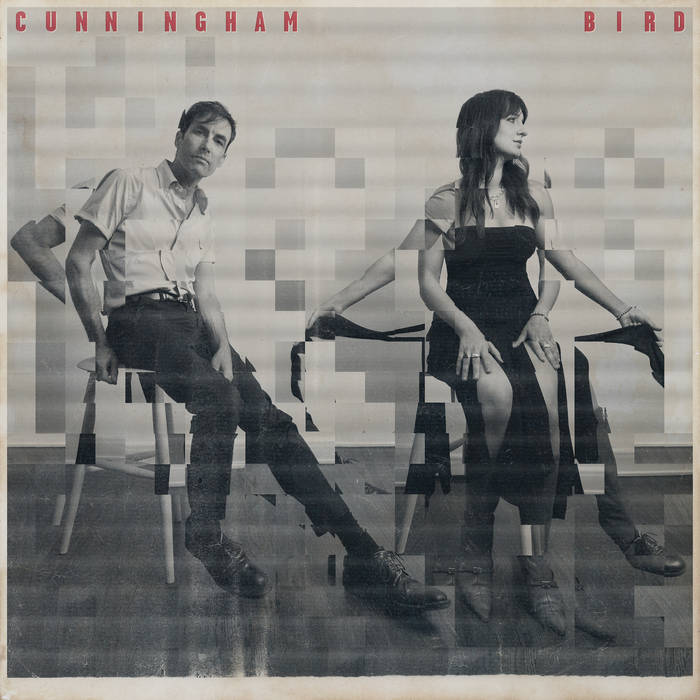
In 1973, aspiring musicians Stevie Nicks and Lindsey Buckingham released their aptly titled album, Buckingham Nicks. Despite the project’s commercial failure, the duo’s songwriting and vocal abilities were clear, and the following year the two were recruited by Fleetwood Mac. I think we know enough of the rest of the story, that the band became an immense success. Buckingham Nicks unfortunately did not. It’s a good album, at least by my standards, but it lacked the press that post-1974 Fleetwood Mac had and still has. Over time, the album faded into the past. Physical copies have been more or less out of print for a while now, and it can’t be found on most streaming services. That is, until Andrew Bird and Madison Cunningham brought it back to life with their album, Cunningham Bird.
Madison and Andrew’s interpretations of each song are far from covers. The only elements left relatively unchanged are chord structures and lyrics, which are still adjusted here and there. Entirely new instrumentals have been composed, informed by contemporary indie folk sensibilities as well as Cunningham’s and Bird’s expertise in acoustic guitar and violin, respectively. A listen to the original album provides some context, yes, but Cunningham Bird can absolutely stand on its own. I didn’t know about the album’s connection to Buckingham Nicks (or that Buckingham Nicks existed in the first place) until after my first several listens, and I loved it nonetheless!
The album begins with its lead single, “Crying In The Night.” Madison’s vocals and Andrew’s violin greets us with a tune that, despite lyrics that prophesize a broken heart, are just fun! The duo’s vocals layer satisfyingly. Each is different but complementary to the other: Madison’s clear and precise, Andrew’s subdued and tender. “Crying In The Night” is a perfect introduction to the project as a whole. It provides a new take on the source material, and wonderfully showcases the power of Cunningham’s and Bird’s collaboration. In retrospect, the only element missing from the latter is Cunningham’s complex fingerstyle guitar, but don’t you fret! We get to hear it in the next song.
What follows is the lyricless “Stephanie.” We finally get that acoustic guitar, with pizzicato violin matching its pitch. When the melody is introduced, it uses a drawn out legato that contrasts the plucked strings that support it. Although built around only a few repeating phrases, the song builds as Cunningham’s vocals and Bird’s smooth, bowed violin weave through the melody. In the final moments of the song, a whistle joins the chorus and adds a sort of haunting color. God, this one is just so beautiful. It gave me chills the first time, and continues to give me chills with each listen. It is my favorite song of the album by far.
“Without A Leg To Stand On” is a wonderful example of how Cunningham’s and Bird’s fresh perspective and willingness to experiment allows the material to flourish. While Buckingham Nicks’s “Without A Leg To Stand On” certainly has its own merits, Cunningham Bird’s changes transform the song into something new and, at least to me, more appealing. In the original chorus, Lindsey sings the melody and Stevie the harmony, which comes in short phrases separated by a few beats between the lyrics. Conversely, Bird and Cunningham pass the melody and harmony back and forth to each other. They draw out each phrase a bit, letting them ease into each other. These changes – the revised rhythm and intertwining of Cunningham and Bird’s vocals – add some intrigue and make the song for me.
“Crystal” is another song that has undergone quite the transformation. From the entire album, the original rendition of this one feels the most dated by far. Cunningham Bird’s slowed tempo and delicate, intimate instrumentation feel far better suited for the ballad’s mystical, pensive lyrics.
In “Django,” a longing, eerie adaptation of the 1960 John Lewis Jazz arrangement, Cunningham uses her voice like a violin. With Bird’s actual violin playing the same melody, the two are almost indistinguishable in timbre if you listen just the right way. So cool!
“Lola (My Love)” is the only song with lyric adjustments that deliberately change its meaning. The original song was written and sung by Lindsey Buckingham and is certainly about objectifying Lola, praising her only for her sexuality. In Cunningham Bird, it is Cunningham who sings this one. She speaks to Lola from an outside perspective, replacing all ‘I’s and ‘me’s with ‘he’s and ‘him’s. Cunningham’s perspective shifts the meaning to feel like an acknowledgement of Lola’s place in her relationship rather than a lust for her. In an interview with Iowa Public Radio Studio One, Bird explains that in the early years of his songwriting career, he “wanted to throw in everything that [he] thought was cool into a song; crazy left turns and wild segues” that were meant to impress. He hears this in Buckingham Nicks as well. Though I’m by no means an expert in songwriting, I can see that Cunningham Bird is a version of Buckingham Nicks with its rough edges resolved, so the flashy things sound intentional.
The vocals on Cunningham Bird are utterly gorgeous. I don’t know how else to put it. In the same interview, Cunningham mentions that few effects were used on the vocals, and that is something I noticed and appreciate. The instrumentation has this quality as well. Some moments, with Bird’s violin in particular, have an imperfect quality that I find charming, raw, and human. With their technical skill and restraint in over-polishing, I can’t help but wish I was close enough to one of their shows to hear this album live. How magical it must be to hear it in person!
Though relatively limited, I had some experience listening to each artist involved with Cunningham Bird before hearing it. Andrew Bird’s Pulaski at Night has lived on my go-to playlist for a few years now, Madison Cunningham’s album Revealer impressed me from my first listen, and both artists gave stunning performances on their respective NPR Tiny Desk Concerts (all of which I’d highly recommend checking out). Of course, I knew the Fleetwood Mac hits. My expectations for Cunningham Bird were high, yet they were still surpassed. An admittedly young and very picky listener, I likely would’ve brushed off Buckingham Nicks as too dated and not something I could truly enjoy, if it had somehow made its way to me without the help of Cunningham Bird. Now, I have a deeper reverence for the minds and music of all parties involved. I’ve already begun my discog-deepdive of each artist.
To not only cover an entire album, but to successfully reinvent it as much as Bird and Cunningham have is an undoubtedly impressive feat. Beyond that, Cunningham Bird surpasses the novelty of its concept. Its earnestness is audible. It’s fascinating to hear such levels of ingenuity within the confines of an album that has already been written. I can only hope to come across a cover project as successful as this one again someday.
 Rodent Reviews
Leave a comment